
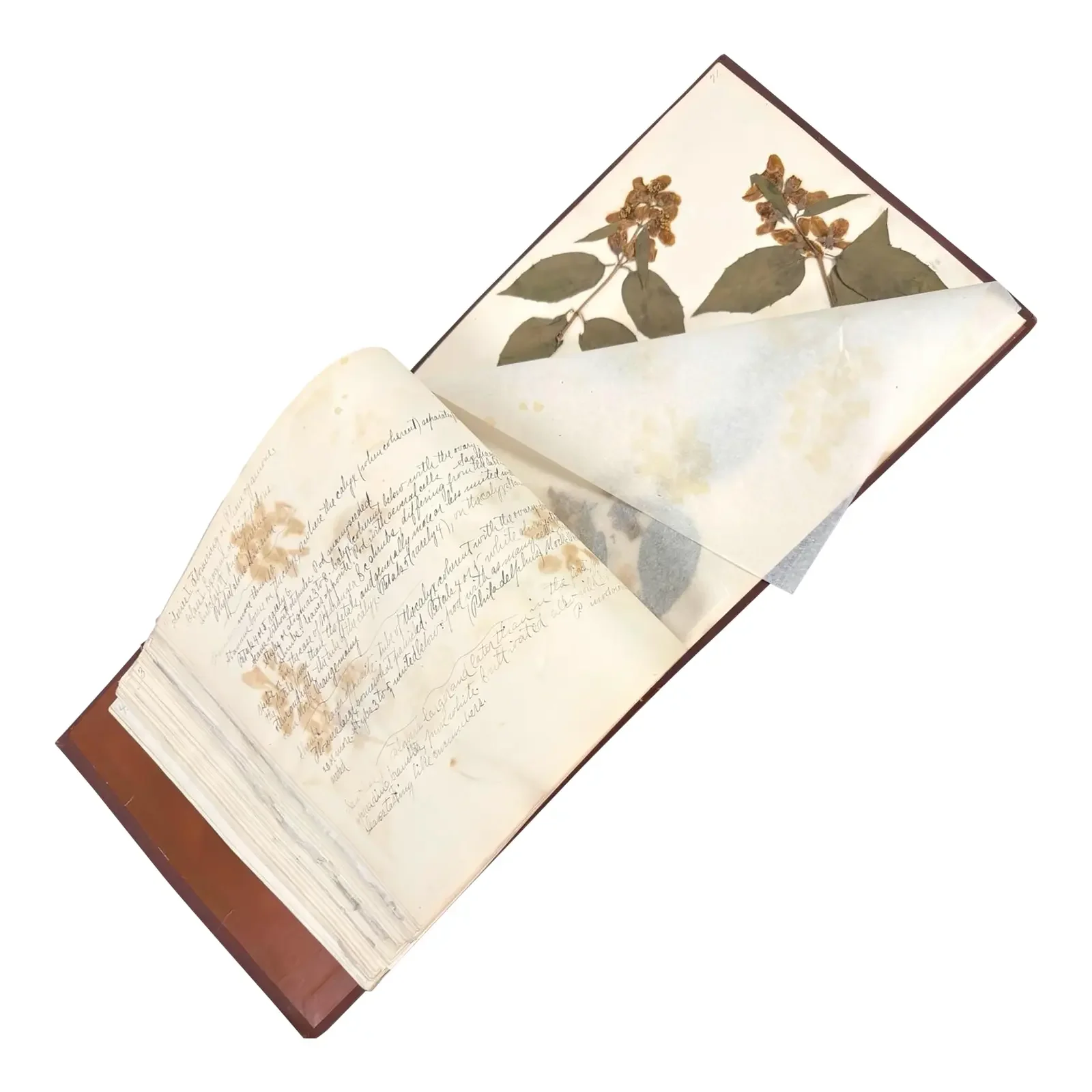
c.1900 Herbarium Album With 26 Specimens, Hand-Drawn Studies & Calligraphic Manuscript
$25.96
- Dimensions
- 12ʺW × 0.75ʺD × 9.5ʺH
- Styles
- Early American
- English Traditional
- Realism
- Period
- 1900 – 1909
- Country of Origin
- United States
- Item Type
- Vintage, Antique or Pre-owned
Shop Sustainably with Velinalorven
- Materials
- Graphite
- Paper
- Condition
- Good Condition, Original Condition Unaltered, Some Imperfections
- Color
- Maroon
- Condition Notes
Very good antique condition overall for a working turn-of-the-century herbarium album, with notably clean and well-preserved pages for the type. …
moreVery good antique condition overall for a working turn-of-the-century herbarium album, with notably clean and well-preserved pages for the type. The album remains intact and presents beautifully as a decorative botanical manuscript object. The Japanese-style side-sewn cord binding remains intact, with burgundy cloth-covered boards showing expected rubbing, fraying, edge wear, surface wear, fading, and handling wear.Interior pages are warmly toned but unusually fresh overall, with light handling wear, minor page-edge wear, tissue creasing, and beautiful organic transfer / ghosting from the pressed botanical material. Heavy foxing, distracting staining, and general page degradation are not defining issues here; the pages are remarkably clean for an album of this age and use.
The pressed botanical specimens are loose-pressed within the album rather than mounted or adhered, held in place by the pages and original interleaving tissue. This is part of the album’s delicate herbarium character. Specimens are naturally fragile and show expected age-related drying, fading, small losses, loose fragments, displacement, and occasional incomplete elements. Some tissue guards are creased, wrinkled, partially loose, or marked by plant transfer.
The handwritten ink note pages and graphite botanical studies remain visually strong, legible, and highly presentable. Please review all photographs carefully, as specimen preservation varies by page.
Fragility & Shipping Note
This album will be shipped closed, carefully supported, and packed to maintain even pressure during transit. Because the botanical specimens are loose-pressed rather than mounted or adhered, minor internal shifting may occur with handling, shipping, or opening, as expected with antique pressed botanical material. The album has been photographed extensively, and a complete page-by-page photo file is available for serious buyers upon request. less
An exceptional turn-of-the-century herbarium and botanical manuscript album, attributed to Paul Benninghofen of Hamilton, Ohio, beautifully interweaving 26 pressed botanical specimens, 26 flowing handwritten ink manuscript note pages, and 12 hand-drawn graphite botanical studies in one intact burgundy cloth-covered album with Japanese-style side-sewn cord binding. Botanical subjects include dogwood, rose-family blooms, lilac, daffodil, trillium, pawpaw, grape, maple, mock orange, geranium, violet, buttercup, waterleaf, monkeyflower, and other woodland, garden, vine, shrub, and native plant forms.
The album has the atmosphere of a private natural-history archive: preserved flowers and leaves laid against warm antique paper, graceful ink handwriting, original graphite studies of plant structures, and beautiful tissue ghosts left by specimens long pressed between the pages. Many specimens retain striking color for their age, including deep olive greens, warm russet petals, ochre blossoms, faded rose, soft mauve, sepia stems, and occasional flashes of violet and blue.
The Benninghofen connection gives the album a particularly strong provenance. The family’s historic Hamilton residence still stands as the Benninghofen House Museum, now operated by the Butler County Historical Society. The society describes the house as a High Italianate-style home filled with Victorian-era furnishings, and notes that the family lived there continuously after John W. Benninghofen purchased it in 1874. Paul Benninghofen later served as president of the Butler County Historical Society from 1951 to 1953, and as chairman of its board of trustees from 1956 to 1974.
The handwriting and drawings are central to the album’s beauty. The note pages are densely written in a fluid period hand, recording plant families, structures, classifications, and distinguishing characteristics, including period botanical terminology such as phanerogamous, monocotyledonous, angiospermous, and polypetalous divisions. The 12 graphite studies add a rare human layer, with careful observations of leaves, stems, blossoms, floral anatomy, seed forms, and plant details.
Offered intact, the album is a commanding object for a library, study, garden room, academic interior, or cabinet-of-curiosities collection. It can be displayed closed, opened on a book stand to a favorite specimen, or rotated through its specimens, manuscript pages, and drawings.
For a designer, collector, or framer, the possibilities are extraordinary. With 26 specimen pages, 26 handwritten ink note pages, 12 original graphite botanical studies, and atmospheric tissue-transfer details, the album contains enough material to create a full library-sized botanical gallery wall. The pages could be framed individually, paired as specimen-and-manuscript compositions, or arranged as a complete natural-history installation from one named archive.
A rare and highly decorative botanical manuscript object: part herbarium, part field notebook, part drawing album, and part preserved natural-history record.
A faint handwritten inscription on the opening page reads:
“Consider the lilies of the field,
how they grow: they toil
not, neither do they spin:
And yet I say unto you,
That even Solomon in all
his glory was not arrayed
like one of these.
Matthew VI. 28–9”
A complete page-by-page photo file is available for serious buyers upon request.
.
Be the first to review “c.1900 Herbarium Album With 26 Specimens, Hand-Drawn Studies & Calligraphic Manuscript”
Related products
Objects & Oddities
Objects & Oddities
Objects & Oddities
Objects & Oddities
Objects & Oddities
Objects & Oddities
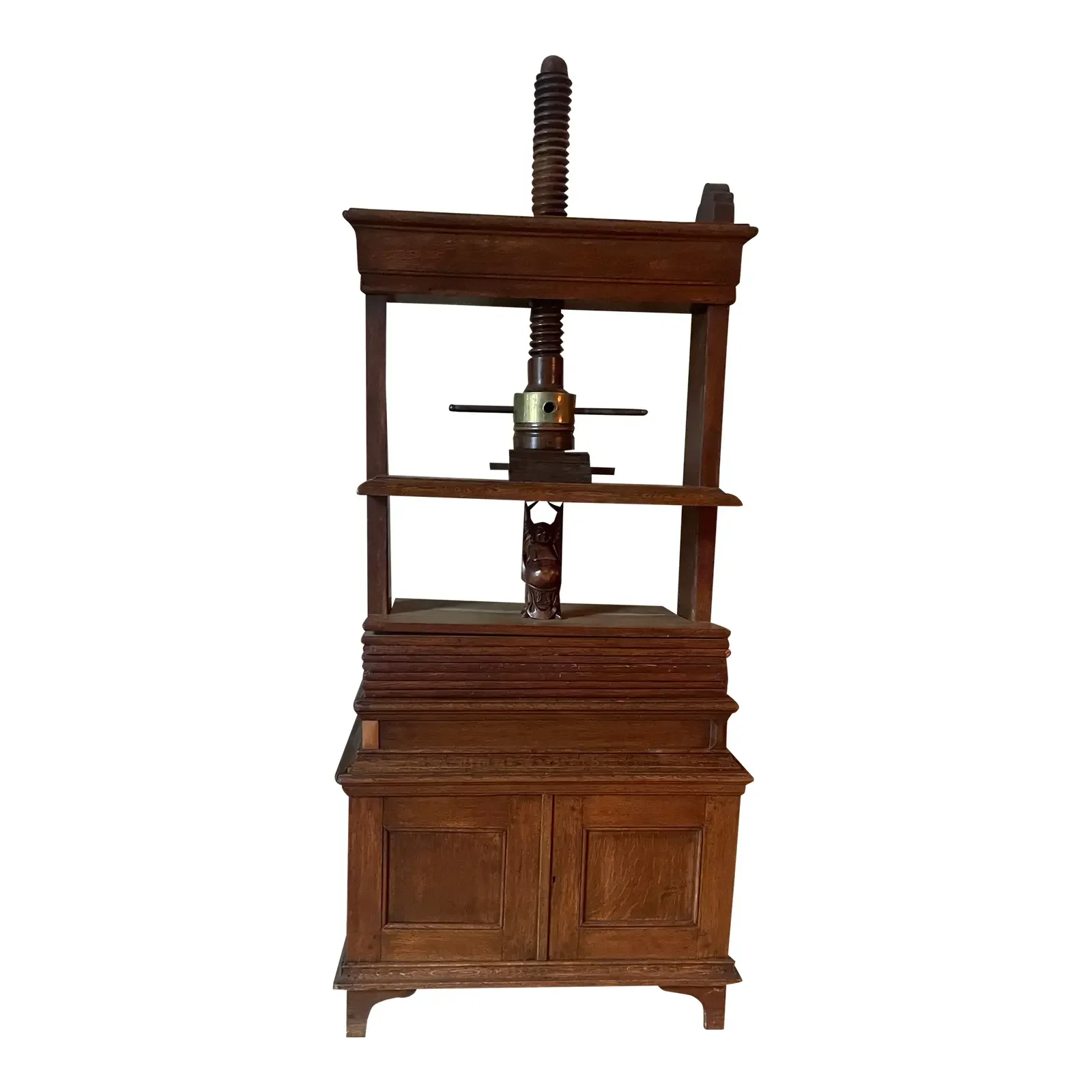
41% Off! Mid 1800’s, Large, European Free-Standing Book Press
Reviews
There are no reviews yet.